01
Representation
Put the work in a form that supports a real decision.
- Distinct item types
- Scope and altitude
- Dependencies and sequence
- Bundles, duplication, and conflict
Priorities · plans · commitments · execution
Priorities.ai helps organizations set clear priorities, align plans and commitments around them, and adapt coherently as conditions change.
What it does
Priorities.ai is a shared record of what your organization decided: what it committed to, which commitments conflict, who may change them and why each decision was made, and whether the work in progress still matches.
| Job | How it works | Without it |
|---|---|---|
| Records commitments | Direction and requests become a short, ranked list of commitments. | Every request competes as a priority. |
| Surfaces conflicts | Commitments that need the same people, budget or time are flagged before work starts, for the accountable people to resolve. | Conflicts appear partway through delivery. |
| Controls changes | Each commitment names who may change it. Changes go through that person and are recorded. | Plans change without a record of who changed them, or why. |
| Keeps the reasons | The criteria and evidence behind each decision stay attached. Earlier versions remain on file. | Settled questions are reopened because the reasoning is lost. |
| Checks the work | Work in progress is compared with what was decided. | Differences surface only after delivery. |
What the platform provides
Priorities.ai connects the representation of work, the rules for working with it, and the commitments that result.
Systems of record
Durable infrastructure. Decades of it.
Strategic Commitment Management
The decision, completed — the choice, the tradeoff, the owner, the conditions.
Systems of execution
Durable infrastructure. Decades of it.
Why structure matters
Once relationships matter, prioritization becomes a portfolio problem—not a simple sorting problem.
Explore the method →What it looks like
Three screens from a demo workspace: the items and what they still need, a Catchball loop in flight, and a working day.
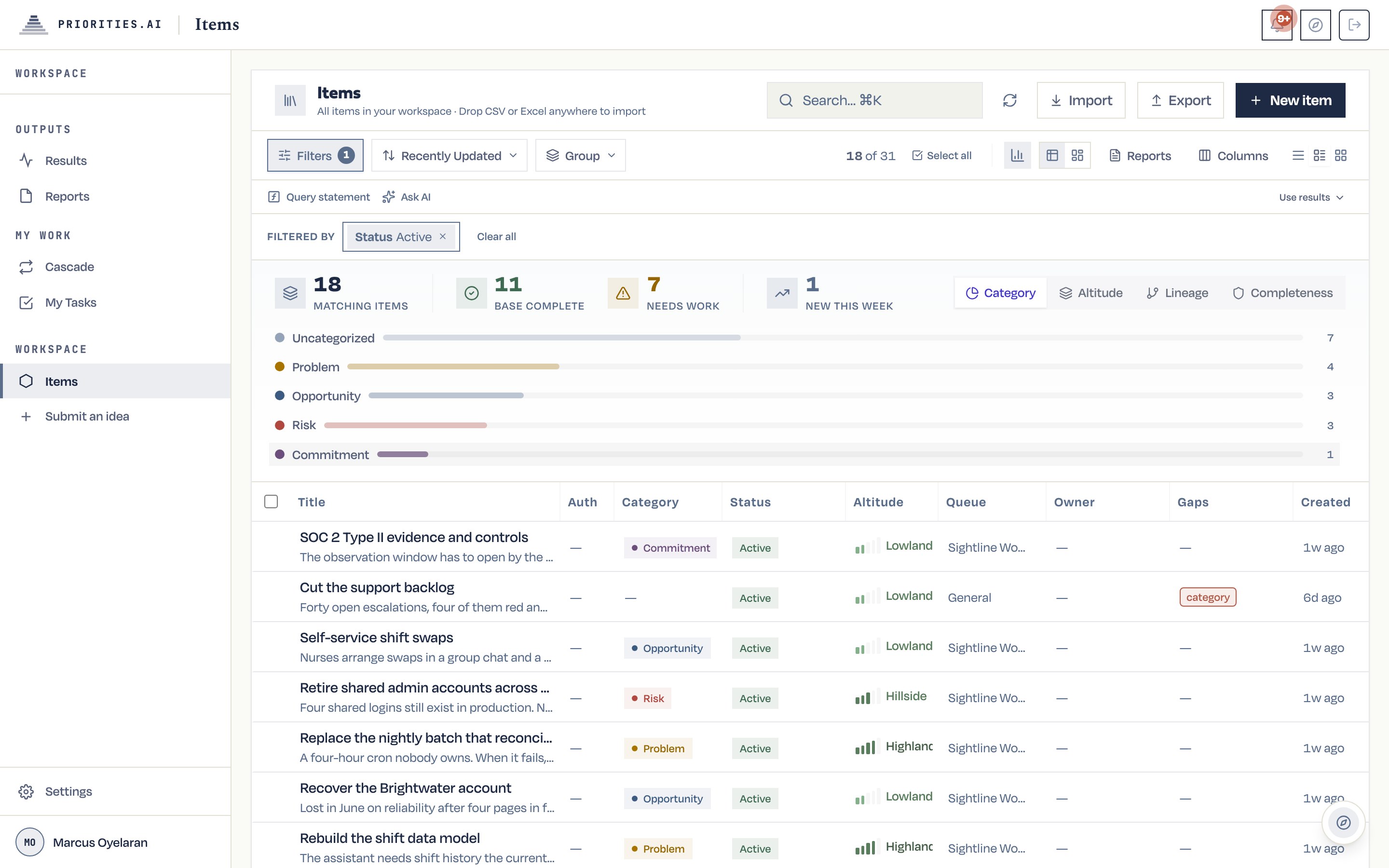
The record
Every item, its category and altitude, who owns it, and what it still needs before it can be compared.
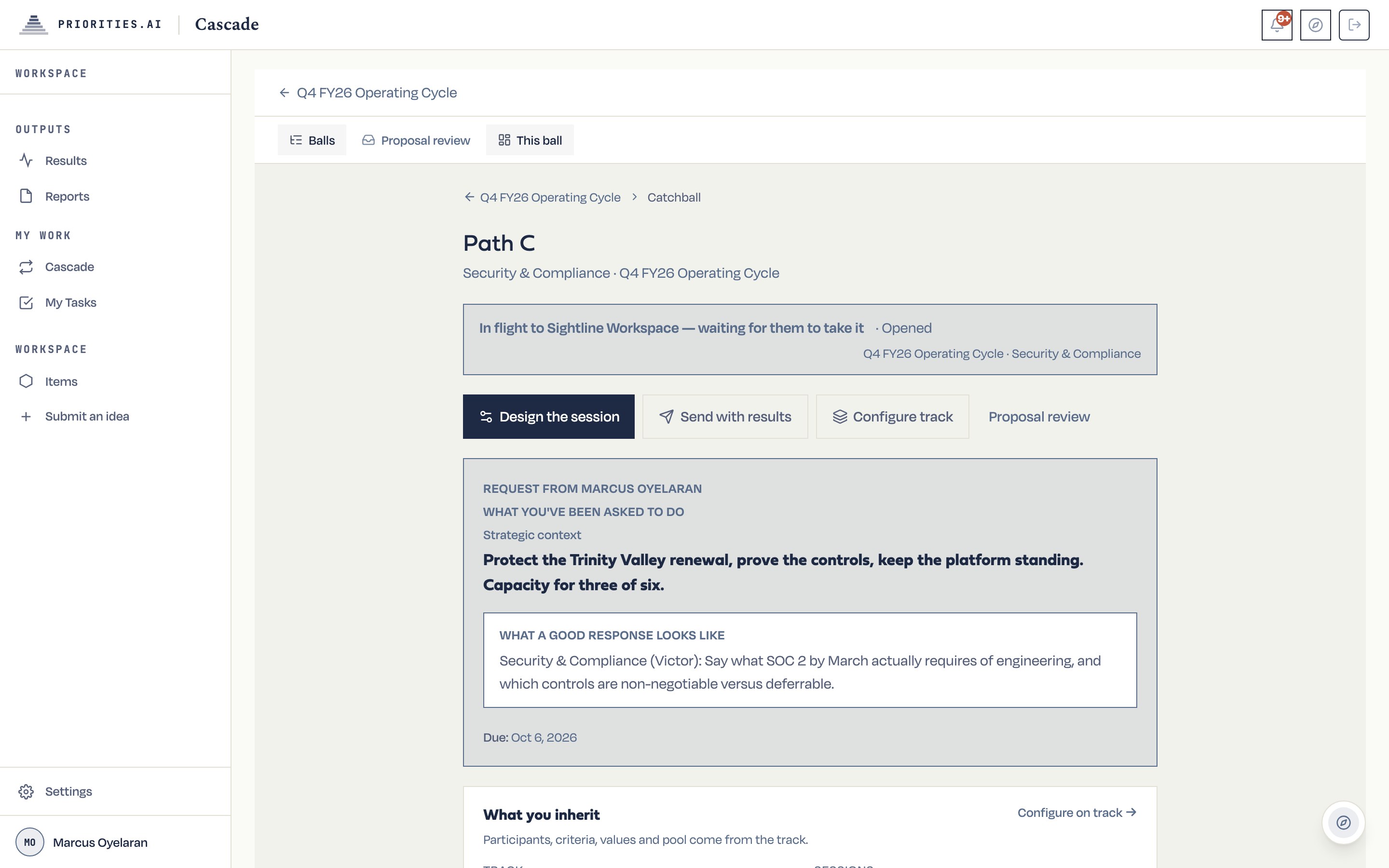
Catchball
Requests go down, proposals come back up. Each loop is on the record until leadership answers.
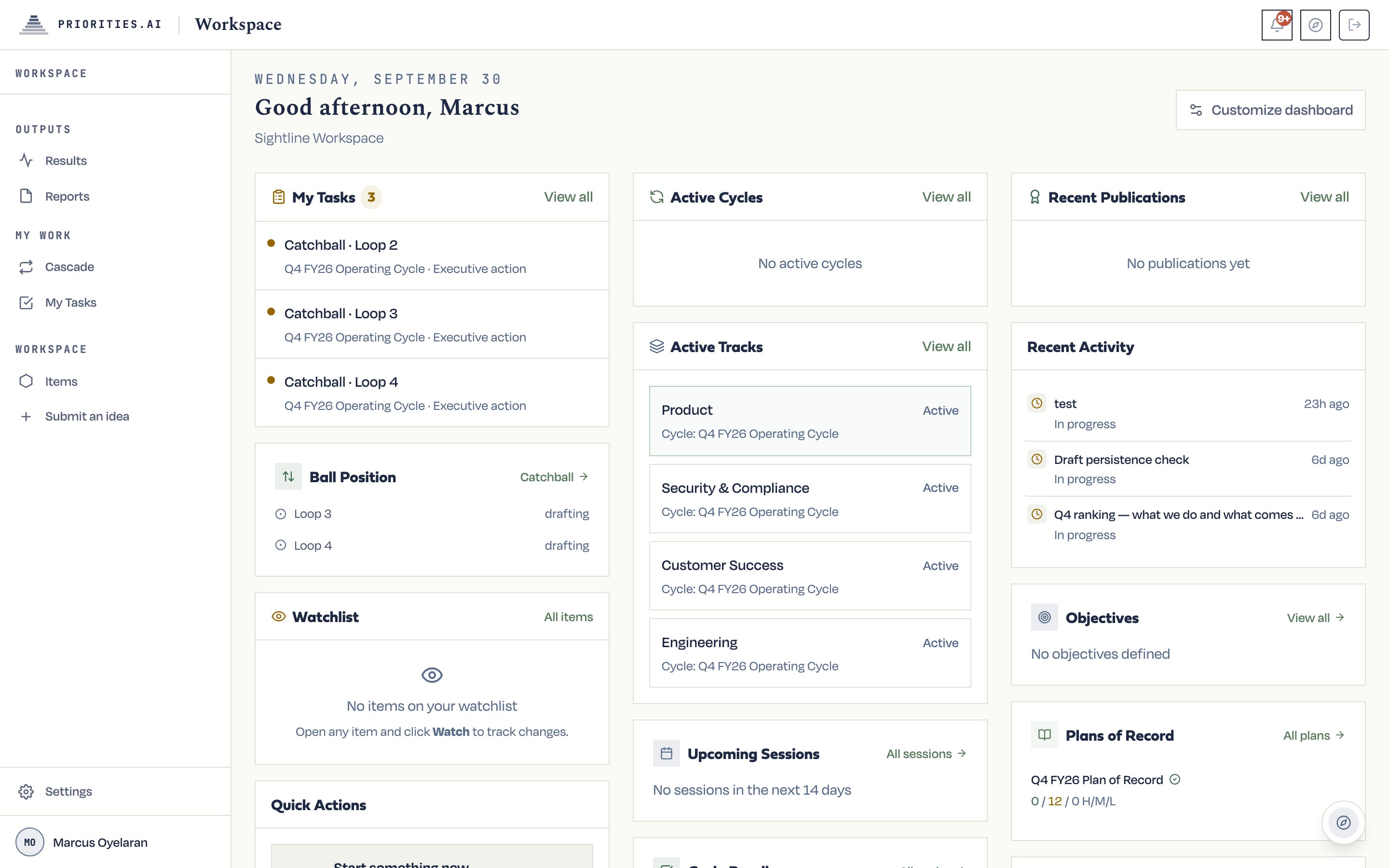
A working day
What needs attention now, what is in flight, and what changed since you last looked.
Who it is for
This is most useful when decisions travel across functions, through several layers, and over time.
See who it is for →Prioritization is recurring and cross-functional, rather than an annual exercise.
The people carrying out the work are often not the people who set direction.
Several parts of the organization generate legitimate priorities and commitments.
Changing course is frequent, consequential, and expensive to absorb.
Leadership wants greater organizational coherence.
How you get it
Priorities.ai is not handed over as a login and a help center. Peak Priorities — the advisory practice behind it — stands it up around your real decisions, runs it with your people, and leaves it with them.
01
Configured to how your organization actually decides: your cycles, your criteria, who holds authority where — connected to the systems your teams already work in.
02
Your first cross-functional decisions go through it, facilitated with your leaders and teams, until the method belongs to the people using it rather than to us.
03
Licensed to you and operated by your team, with the record of every decision made along the way. We stay involved at whatever depth you want — including none.
Priorities.ai
Bring a live cross-functional decision. We’ll show you how the structure works around something that matters.
Start a conversation